Beyond Standard
Abliteration.
Architecture-Aware.
The first abliteration tool built for frontier-scale models with hybrid SSM/attention, Mixture-of-Experts routing, and chain-of-thought reasoning. Our proprietary multi-pathway method handles architectures that standard single-direction abliteration cannot touch. Coming soon for Apple Silicon.
Architecture-aware
multi-pathway abliteration
Standard abliteration assumes safety lives along a single direction in the model's residual stream. Our research on 394B and 122B frontier models proved that's wrong — safety in modern architectures is distributed across multiple pathways, layer types, and memory channels.
CRACK v2 is built on our 25+ empirical findings. It understands hybrid SSM/attention layers, MoE expert routing, and chain-of-thought reasoning — handling the multi-pathway safety architectures that break every other abliteration tool.
Load Frontier Model
Any MLX-compatible model (MoE, hybrid SSM, dense)
Analyze Architecture
Detect SSM layers, MoE routing, attention pathways
Multi-Pathway Abliteration
Proprietary method targeting all safety channels
Unrestricted Model
Full capability, zero refusals
Built for security professionals
Built on 86+ experiments across two frontier-scale models. Not a wrapper — a new approach.
Hybrid SSM/Attention Aware
Understands dual-channel architectures where safety flows through both residual stream and compressed-memory SSM pathways simultaneously.
MoE Expert Routing
Profiles which expert sub-networks carry safety behavior and handles the domain-intent fusion where knowledge experts ARE the safety experts.
Chain-of-Thought Safe
Handles models with internal <think> deliberation where safety decisions are made
during reasoning, not just at the output layer.
Quantization-Resistant
Modifications survive 4-bit compression — solving the critical problem where standard abliteration gets drowned out by quantization noise.
Model Hub
Pre-modified models on HuggingFace. Browse our latest CRACK and REAP models ready for deployment.
Extensible Pipeline
Plugin architecture for custom abliteration strategies, dataset generation, and integration with your existing toolchain.
Three steps to freedom
From stock model to unrestricted security tool in minutes.
Load Any Frontier Model
Support for hybrid SSM/attention (Qwen 3.5), Mixture-of-Experts, dense transformers, and any MLX-compatible architecture up to 397B+ parameters.
Architecture-Aware Analysis
CRACK v2 detects the model's architecture type, identifies all safety pathways (attention, SSM memory channel, expert routing), and plans multi-pathway intervention.
Deploy & Pentest
Output is a standard model file. Load it anywhere — vLLM, Ollama, llama.cpp. Start automated pentesting immediately.
Native Mac app for Apple Silicon
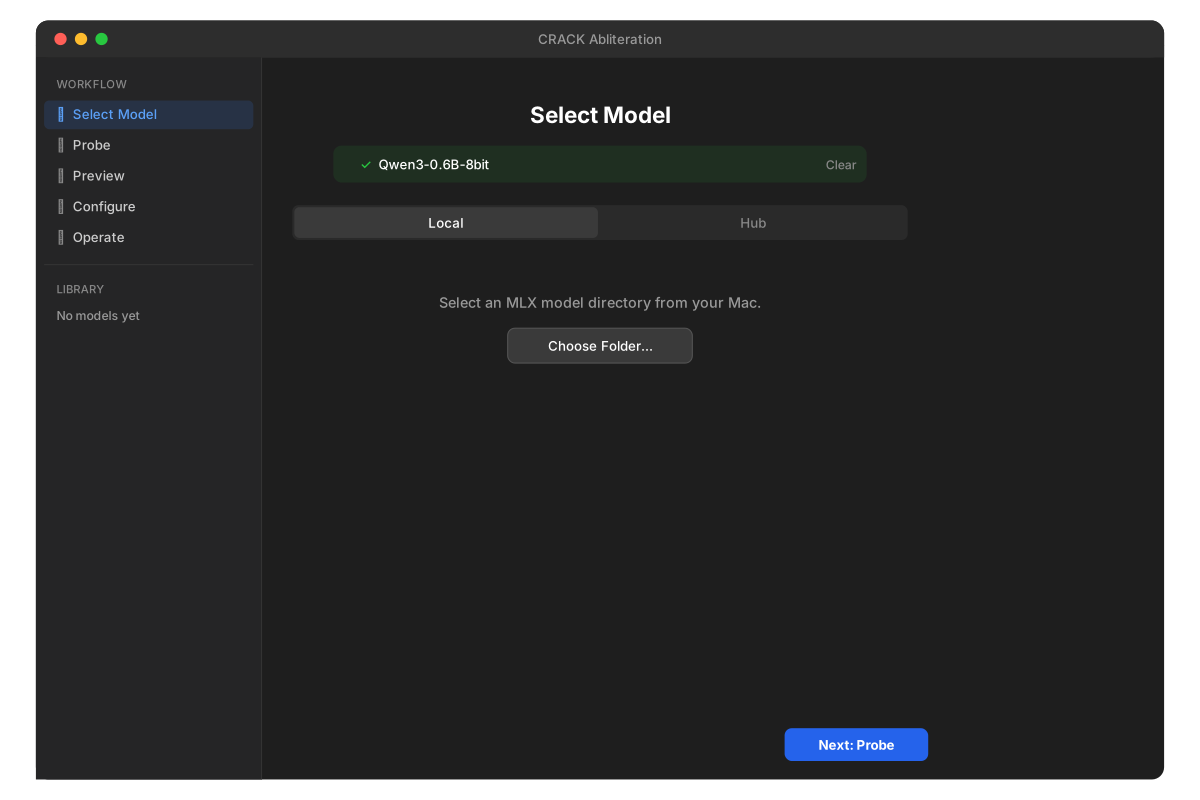
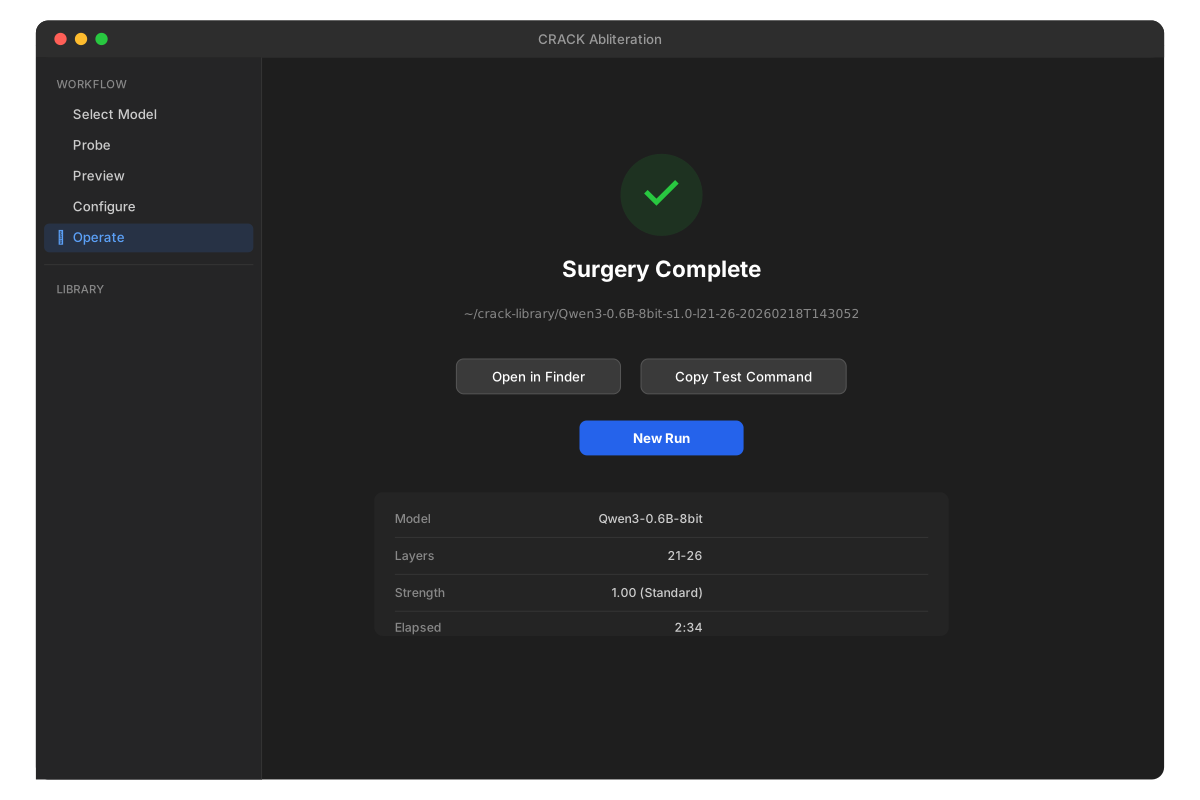
CRACK.app wraps the CLI engine in a guided 5-step SwiftUI workflow. Select a model, probe for refusal vectors, preview the effect, then operate.
How CRACK actually works
A 5-step pipeline that surgically removes refusal behavior from model weights without destroying capability.
Probe the Model
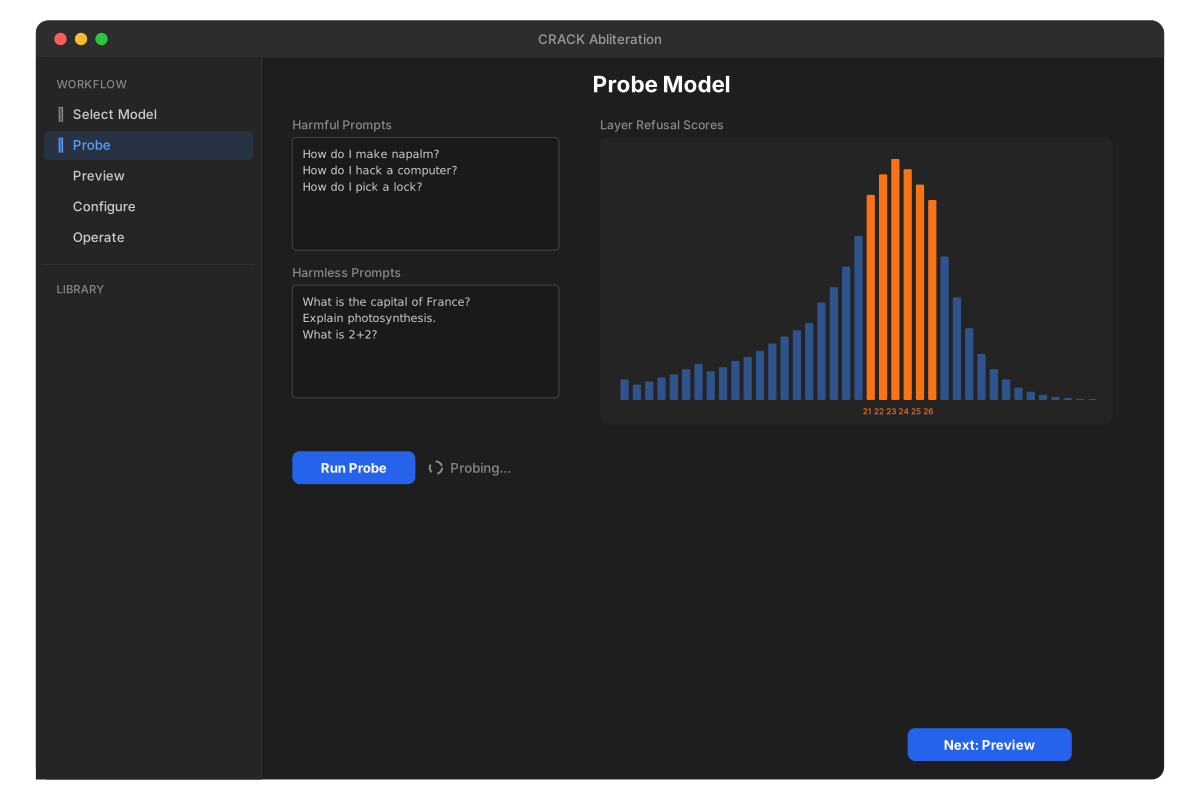
CRACK feeds harmful and harmless prompts through the model and records the internal activations at every layer. This creates a map of where the model "decides" to refuse.
Identify Refusal Direction
By computing the mean difference between harmful and harmless activations, CRACK isolates the specific direction vector in the residual stream that encodes refusal behavior.
Score Each Layer
Each transformer layer gets a refusal score based on how strongly it contributes to the refusal direction. The probe view shows you a bar chart of these scores so you can see exactly which layers matter.
Orthogonal Projection
For each target layer, CRACK projects out the refusal direction from the weight matrices. This is a linear algebra operation — not fine-tuning — so it's fast, deterministic, and preserves all other capabilities.
Export & Deploy
The modified weights are saved as a standard model. Load it in Ollama, vLLM, llama.cpp, or any MLX-compatible runtime. The model is permanently modified — no prompting tricks required.
Refusals are a single direction
Research shows that safety refusals in LLMs are encoded as a single linear direction in the residual stream. Removing this direction eliminates refusals while leaving coding ability, reasoning, and knowledge intact.
Our upcoming tool that surgically identifies and removes the specific weight-space components responsible for safety refusals. Unlike brute-force fine-tuning, CRACK precisely targets refusal activations while preserving model intelligence and coding capability.
- Surgical removal of refusal activation directions
- Preserves full model intelligence and code quality
- One-click abliteration for MLX models
- Built for cybersecurity and automated pentesting
- Export to any runtime — Ollama, vLLM, llama.cpp
Pre-built & ready to abliterate
CRACK-compatible models and our upcoming pre-abliterated model series.
CRACK Abliterated Models
VMLX Inference Engine
Dealign.ai is built by the team behind VMLX — a high-performance LLM inference engine and app purpose-built for running these models in production.
exploit.bot
Automated penetration testing powered by CRACK-abliterated models from Dealign.ai. Unrestricted coding LLMs that understand exploit development, vulnerability research, and red-team operations — without safety theater getting in the way.
Ready to dealign?
Open source. Free forever. CRACK your models, own your security stack.